
What Anti-aging Effects Can Palmitoyl Tetrapeptide-7 Actually Bring To Skincare Products?
First, it’s essential to understand what Palmitoyl Tetrapeptide-7 is.
At its core, it’s a small peptide composed of four amino acids linked to a palmitoyl group—a structure that gives it excellent lipophilic properties, allowing it to easily penetrate the skin’s lipid barrier and reach the deeper dermal layers where aging begins. Unlike harsh traditional Anti-aging ingredients like retinol, which often cause irritation, this peptide works by mimicking the skin’s natural signaling molecules, making it gentle yet effective.
- The key anti-aging power of Palmitoyl Tetrapeptide-7 starts with fighting chronic inflammation—the "silent driver" of skin aging.
Modern dermatology has confirmed that long-term low-grade inflammation triggers a domino effect: it activates enzymes that break down collagen, damages the skin barrier, and leads to dullness and wrinkles. Palmitoyl Tetrapeptide-7 targets this problem at the source by inhibiting the NF-κB signaling pathway, which regulates the release of pro-inflammatory cytokines like IL-6 and TNF-α.
A 2010 study published in the Journal of Cosmetic Science found that this peptide significantly reduced IL-6 levels in human keratinocytes, effectively blocking inflammatory cascades.
In practical terms, this means less redness, fewer irritation-related lines, and a calmer skin environment.
- Beyond reducing inflammation, Palmitoyl Tetrapeptide-7 excels at boosting collagen and elastin production—critical for maintaining skin firmness and smoothness.
As we age, fibroblasts (the cells that make collagen) become less active, leading to thinner skin and deeper wrinkles. This peptide acts as a "signal booster" for these cells: research by Zhang Y. et al. in the 2015 Experimental Dermatology demonstrated that Palmitoyl Tetrapeptide-7 stimulates fibroblasts to synthesize more Type I and Type III collagen, the two main structural proteins in healthy skin. Clinical data reinforces this: a third-party double-blind study found that using a formulation with 0.2% Palmitoyl Tetrapeptide-7 for 28 days increased collagen density by 58.3% and reduced nasolabial fold depth by 19.7%. After 8 weeks of use, participants saw a 30% improvement in skin firmness and a 37.2% reduction in under-eye fine lines.
- Another major advantage is its ability to repair the skin barrier while anti-aging.
A strong barrier prevents moisture loss and protects against environmental damage, but aging and irritation weaken it over time. Palmitoyl Tetrapeptide-7 addresses this by upregulating proteins like Claudin-1, which strengthen the "brick-and-mortar" structure of the epidermis. Experiments show it reduces transepidermal water loss (TEWL) and accelerates the healing of damaged skin cells. For sensitive skin users, this is a game-changer: a study of 40 volunteers using a cream with 5% of the peptide found a 58% reduction in redness and 63% less stinging after 4 weeks.
- What makes Palmitoyl Tetrapeptide-7 even more valuable for skincare products is its versatility and compatibility.
Its small molecular weight (≤805 Da) gives it a transdermal absorption rate of over 90%, ensuring it delivers results without needing high concentrations. It remains stable across a wide pH range (3.0-8.5), making it suitable for serums, creams, masks, and ampoules.
*Unlike retinol, it has no photosensitivity and requires no tolerance building, so it can be used morning and night.
*It also works synergistically with other ingredients: combining it with vitamin C doubles antioxidant and anti-glycation effects, while pairing it with ceramides boosts barrier repair by 42%.
*A 2018 study in the International Journal of Cosmetic Science further found it has anti-glycation properties, reducing the formation of age-related dullness-causing compounds by 45%.
In the cosmetic industry, Palmitoyl Tetrapeptide-7 has already become a staple in both high-end and efficacy-focused brands—and its market footprint is growing at a remarkable pace.
Take the Chinese market as an indicator: 2024 saw the country’s Palmitoyl Tetrapeptide-7 raw material market reach 8.6 billion yuan (approximately $1.2 billion), marking a 19.4% year-on-year growth . This surge is directly tied to rising consumer demand for science-backed anti-aging products and increased R&D investment from domestic beauty brands. Downstream, the market for finished skincare products containing the peptide exceeded 47 billion yuan in 2024, with a 23.7% growth rate . Brands like Proya and Winona have launched peptide-centric lines that drove this expansion—Proya’s Ruby Serum, featuring Palmitoyl Tetrapeptide-7, reached 930 million yuan in 2024 sales alone .
Regionally, the ingredient is concentrated in high-value products: 72% of Palmitoyl Tetrapeptide-7 is used in facial serums, 18% in eye creams, and the rest in creams and post-procedure repair products . This aligns with consumer willingness to invest in targeted anti-aging solutions.
On the supply side, manufacturers are scaling up to meet demand: China’s total Palmitoyl Tetrapeptide-7 production is projected to hit 11,200 kilograms in 2025, a 28.7% increase from 2024 . Key players like Bloomage Biotech and Zhejiang Peptide Biotech now control over 65% of domestic capacity,with technological advances narrowing the quality gap between domestic and imported raw materials . For example, Zhejiang Peptide Biotech’s automated synthesis platform achieves 99.2% purity, comparable to German Merck’s 1,650 yuan-per-gram imports but at a more accessible 980 yuan-per-gram price point .
Looking ahead, the market prospect for Palmitoyl Tetrapeptide-7 is exceptionally bright. Analysts predict China’s raw material market will grow to 10.2 billion yuan in 2025 (18.6% growth) and exceed 11 billion yuan by 2026, with a compound annual growth rate above 25% .
Several factors are fueling this momentum:
- Consumer Demand for "Science-Backed" Skincare: As shoppers prioritize ingredients with clinical evidence over marketing, Palmitoyl Tetrapeptide-7’s research-backed benefits resonate strongly—especially with the 30-50 age group seeking gentle anti-aging solutions.
- Rise of Light Medical Aesthetics: Post-procedure skin needs gentle, reparative anti-aging ingredients, and Palmitoyl Tetrapeptide-7’s barrier-repairing and anti-inflammatory properties make it ideal for this fast-growing segment.
- Policy Support: China’s "14th Five-Year Plan for Bioeconomy" identifies functional peptides as a priority, with 120 million yuan in 2024 funding for synthesis technology optimization . This policy clarity is attracting new investment.
- Global Expansion: Domestic producers are now exporting to South Korea, Japan, and Singapore—2025 export volumes are expected to reach 0.68 tons, generating $120 million in revenue —signaling Palmitoyl Tetrapeptide-7’s growing global relevance.
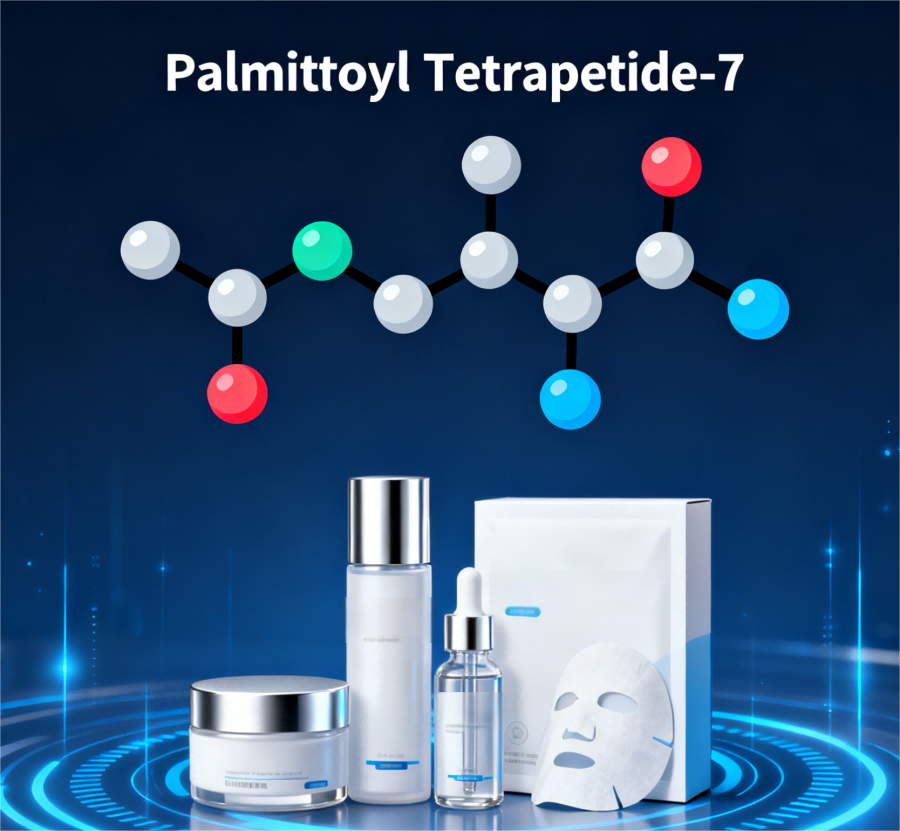
The evidence is clear: Palmitoyl Tetrapeptide-7 offers a rare combination of anti-inflammatory, collagen-boosting, and barrier-repairing benefits, all backed by peer-reviewed research.
Its market growth reflects this value proposition, with data pointing to sustained expansion as consumers and brands alike prioritize effective, gentle anti-aging ingredients. Whether you’re dealing with early fine lines, loss of firmness, or sensitivity-related aging, products containing this peptide provide a solution that’s both scientifically validated and commercially proven.
When choosing skincare with Palmitoyl Tetrapeptide-7, look for transparent concentration labeling (0.1%-0.5% is ideal) and formulas with complementary ingredients like hyaluronic acid or ceramides. With consistent use, this peptide can help turn back the clock on skin aging—without the irritation of traditional ingredients. And as its market presence grows, consumers can expect even more innovative, accessible products featuring this powerhouse peptide.
- Name: Yuki
- E-mail: sales02@nahanutri.com
- WhatsApp:+8618066950297